

Turning Up the Heat on Green IT: From Data Centres to Sustainable Code
From data centres to AI models, technology’s carbon footprint is rising, but innovative solutions in green IT offer a way to transform this challenge into an opportunity.
The IT industry is both a driver of climate solutions and a significant contributor to global emissions. From data centres to AI models, technology’s carbon footprint is rising, but innovative solutions in green IT offer a way to transform this challenge into an opportunity.
Nowadays, data centres are warming up with climate-based algorithms, which in turn produce insights as well as emissions. The tech industry’s rising carbon footprint is presenting a new challenge, transforming information technologies (IT) to green. Some vital statistics present the inevitability in this regard:
- According to a report of the International Energy Agency (IEA) in 2024, data centres and Artificial Intelligence (AI) are expected to consume up to 8% of global electricity by 2030.
- Training a single large AI model can emit as much CO₂ as five cars over their lifetime, says MIT Tech Review.
- Information and Communication Technology (ICT), from the devices used to cloud networks, is responsible for almost 4% of global emissions, and this rate is quickly increasing.
The Rise of Sustainable Computing
Making computing sustainable is another hard task, which will force the IT industry to redesign, build, and set most of the digital infrastructure.
Energy-efficient computing, aka green computing, requires four progressive tactics to result in energy efficiency, says Gartner:
- Improve how current hardware is used by increasing efficiency, streamlining algorithms and data formats, and relying more on cleaner energy sources.
- Upgrade outdated, inefficient hardware when the energy savings and lower emissions from new systems outweigh the carbon cost of manufacturing and replacing them.
- Redesign applications by modifying their code or moving them to more efficient platforms, for instance, switching from general-purpose processors to GPUs or FPGAs.
- Transform applications through next-generation computing technologies, such as neuromorphic or optical systems, once these solutions are fully developed and ready for practical use.
Preparation Towards Sustainable IT
Preparation towards sustainable IT will also be challenging, as companies must:
-
IT teams need reliable ways to measure and track energy use so they can identify which systems will benefit most from improvement.
-
Green IT is a fast-moving field, with both technologies and standards evolving quickly.
-
Many of the solutions with the biggest potential impact are still emerging and not yet ready for large-scale use.
Furthermore, the immense expansion of Generative AI is kicking up the energy required for computation, accelerating the emergence of new computing tech, including neuromorphic computing, optical computing, and quantum computing. These technologies are expected to deliver energy-efficient hardware options in the next 10 years, says Gartner, through a diligent preparation that companies need to undertake.
The required transformation won’t be an independent endeavour eventually, as many countries and regions have established regulations. For the European Union (EU), it is the European Corporate Sustainability Reporting Directive (CSRD), aiming to increase transparency over sustainable information, establish mandatory, standardised reporting rules to ensure reports are consistent and comparable across companies. Thus, promoting sustainability among companies through reporting on their environmental and social impacts, risks, and opportunities.
Reporting on environmental, social, and governance (ESG) impacts, risks, and opportunities and optimising IT infrastructure is not easy. According to a PwC study in 2023, around 64% of the organisations reporting for the CSRD find the technical complexity quite challenging. For 74% of the organisations, the technical complexity is caused by the necessity of considering the entire value chain.
Key Steps for Going Green in IT
According to a report of the Boston Consulting Group (BCG) in 2023, the ICT industry contributes 2% of global greenhouse emissions (GHG).
ICT companies could enable up to around 10 gigatons (Gt) of GHG reductions by 2030, BCG says. According to BCG, five major industries can achieve breakthroughs in reducing emissions through green IT by the same year:
-
Energy industry: around 1.8 Gt CO₂ equivalent (CO₂-e) through tech such as smart grid and renewable energies
-
Buildings: Smarter buildings with significantly lower energy and water use can reduce emissions up to 2 GtCO₂-e
-
Food & agriculture: Around 2 GtCO₂-e through smarter irrigation, waste reduction, etc.
-
Mobility & logistics: Through smarter transport systems, supply chain, and logistics, there could be 3.6 GtCO₂-e
-
Manufacturing: Integrating smarter production models and circular supply chains can result in 2.7 GtCO₂-e
In short, balancing the environmental and business requirements has opened up a new front for companies. In the big picture, achieving Green IT may depend on success in five critical areas:
-
Acknowledging the role of software: The energy consumption to design, maintain, and run applications of end-user devices.
-
Achieving sustainable software development: By increasing efficiency in all the steps of the software development lifecycle (SDLC). Benchmark studies from 2017 and 2024 show that languages like Python can consume tens of times more energy than lower-level languages during heavy computing tasks. Newer versions and interpreters have narrowed the gap, but significant differences remain.
-
Boosting green tech investments: A McKinsey study from 2022 simply puts it as, “Achieving green impact doesn’t have to mean increasing costs or sacrificing profit.”
-
Adjusting IT infrastructure to green: Making software development energy efficient, switching to renewable energy-based data centres and working with utility companies promoting renewable solutions would be a good plan.
-
Achieving a sustainable IT procurement: Selecting the key performance indicators (KPIs) for energy usage and CO₂ consumption, working with greener vendors and choosing energy-efficient hardware would be key steps in IT procurement. Choosing hardware with low carbon footprints, making use of them as much as possible and then recycling them is quite important. For instance, a 2019 study showed that 80% of smartphone carbon footprint occurs during the production process, 16% in consumer use, and 3% in the transport process. A 2021 study showed that production of a typical EV can produce around 4 tonnes of CO₂, with the battery representing 18% of it. Like fleet procurement, IT procurement is complex and will require more calculations to make decisions.
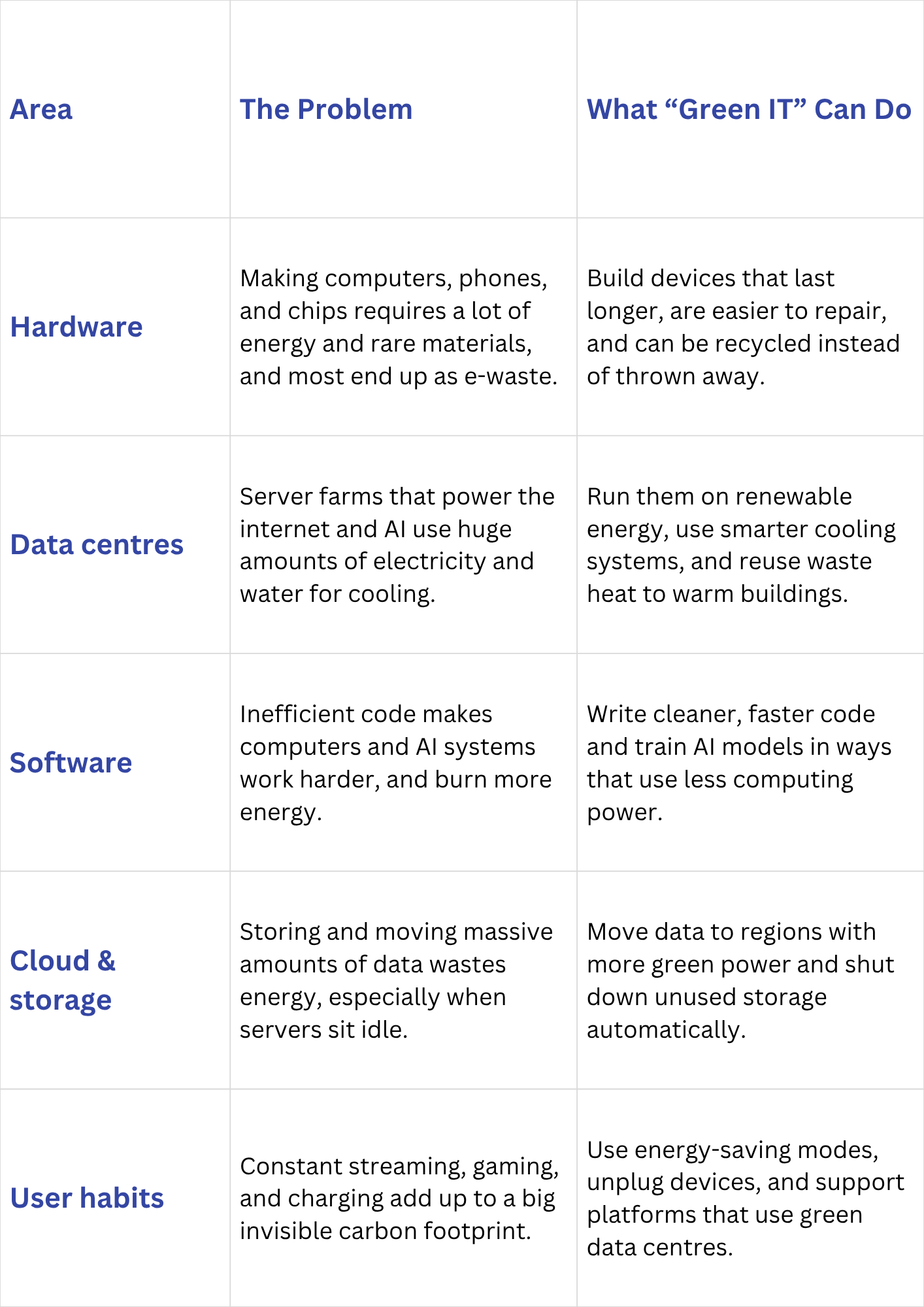
Who Can Lead the Way?
The data centres? Reusing the heat generated by data centres is an improving area in green IT and highly promising for using heat meaningfully, especially in winter. According to figures from Data Centre Magazine, the average Power Usage Effectiveness (PUE) for data centres was 1.55 in 2022, down from about 2.5 in 2007, showing how cooling/energy efficiency has improved.
Data centres have started using the Energy Reuse Factor (ERF) to measure the amount of reused energy. Microsoft estimates that data centres could reuse up to 69% of their energy in winter months and up to 86% in summer, under ideal conditions.
An interesting fact is that from Odense, Denmark, where Meta operates two 50,000 m² data centres, connected to a district-heating scheme. Powered by renewables, the heat recovered is expected to be around 100,000 MWh annually (after 2025), enough to heat about 6,900 homes.
The Rising Trend: Re-allocating Waste Heat
Using the waste heat produced nonstop by data centres, especially in swimming pools, is a positive change for all humanity. The pilots began in the UK and are showing highly successful results.
Led by Deep Green (and invested by Octopus Energy), 150 swimming pools in the UK may become eligible for heat transferred from data centres. Around 1.5% of global electricity is consumed by the data-centre industry, according to Energy Digital, and could be turned into several uses:
-
In Sweden, data‑centre waste heat is used in greenhouse growing microgreens.
-
In Norway, a collaboration between a data centre and a lobster farm is being used to heat seawater for crustaceans.
-
In Japan (Hokkaido), one data centre’s cooling system expels water at ~33 °C, used to raise fish in aquaculture.
Many countries are taking steps to benefit from the waste heat. Germany will require data centres to reuse 10% of their waste heat from 2026, under the Energy Efficiency Act.
Another example is Amazon’s data centre in Tallaght, Dublin, where waste heat is transferred from servers to an air‑handling unit, then via heat pumps to warm water. Results include around 1,500 tons of CO₂ annual reduction and provide heating for a large local building stock (public buildings, commercial space, apartments).
These examples show how IT can simultaneously reduce emissions and turn waste into valuable heat, promoting applications of Green IT. As natural gas prices are expected to drop 7% in Europe by 2030, the adoption of renewables will eventually support Green IT.
This article was originally published on Substack.
Sources
-
Gartner. Green Computing. https://www.gartner.com/en/articles/green-computing
-
Software Improvement Group. Green IT Strategies for Business Leaders. https://www.softwareimprovementgroup.com/green-it-strategies-for-business-leaders/
-
EUR-Lex. Corporate Sustainability Reporting Directive (CSRD). https://eur-lex.europa.eu/legal-content/EN/TXT/?uri=CELEX:32022L2464
-
PwC. The Corporate Sustainability Reporting Directive is already having an impact. https://www.pwc.nl/en/topics/sustainability/esg/corporate-sustainability-reporting-directive/the-corporate-sustainability-reporting-directive-csrd-is-already-having-an-impact.html
-
European Commission. Corporate Sustainability Reporting. https://finance.ec.europa.eu/capital-markets-union-and-financial-markets/company-reporting-and-auditing/company-reporting/corporate-sustainability-reporting_en
-
Green Coding. Energy Efficiency Python Case Study. https://www.green-coding.io/case-studies/energy-efficiency-python/
-
McKinsey & Company. Playing Offense with Green Tech to Achieve Net Zero Emissions. https://www.mckinsey.com/capabilities/tech-and-ai/our-insights/playing-offense-with-green-tech-to-achieve-net-zero-emissions
-
Earth.org. Environmental Impact of Battery Production. https://earth.org/environmental-impact-of-battery-production/
-
UNEP. Your phone, really smart. https://www.unep.org/news-and-stories/story/your-phone-really-smart
-
Data Centre Magazine. Data Centres: Heat Reuse for a Low Carbon Future. https://datacentremagazine.com/data-centres/data-centres-heat-reuse-for-a-low-carbon-future
-
Energy Digital. Waste Heat Re-used Worldwide to Heat Public Facilities. https://energydigital.com/articles/waste-heat-re-used-worldwide-to-heat-public-facilities
-
Data Centre Magazine. The Future of Low Carbon Heat with Mitsubishi Electric. https://datacentremagazine.com/critical-environments/the-future-of-low-carbon-heat-with-mitsubishi-electric
-
Hao, K. (2019, June 6). Training a single AI model can emit as much carbon as five cars in their lifetimes. MIT Technology Review. Retrieved from https://www.technologyreview.com/2019/06/06/239031/training-a-single-ai-model-can-emit-as-much-carbon-as-five-cars-in-their-lifetimes/
-
European Commission. (n.d.). Corporate sustainability reporting. Finance – Capital Markets Union & Financial Markets. Retrieved from https://finance.ec.europa.eu/capital-markets-union-and-financial-markets/company-reporting-and-auditing/company-reporting/corporate-sustainability-reporting_en